
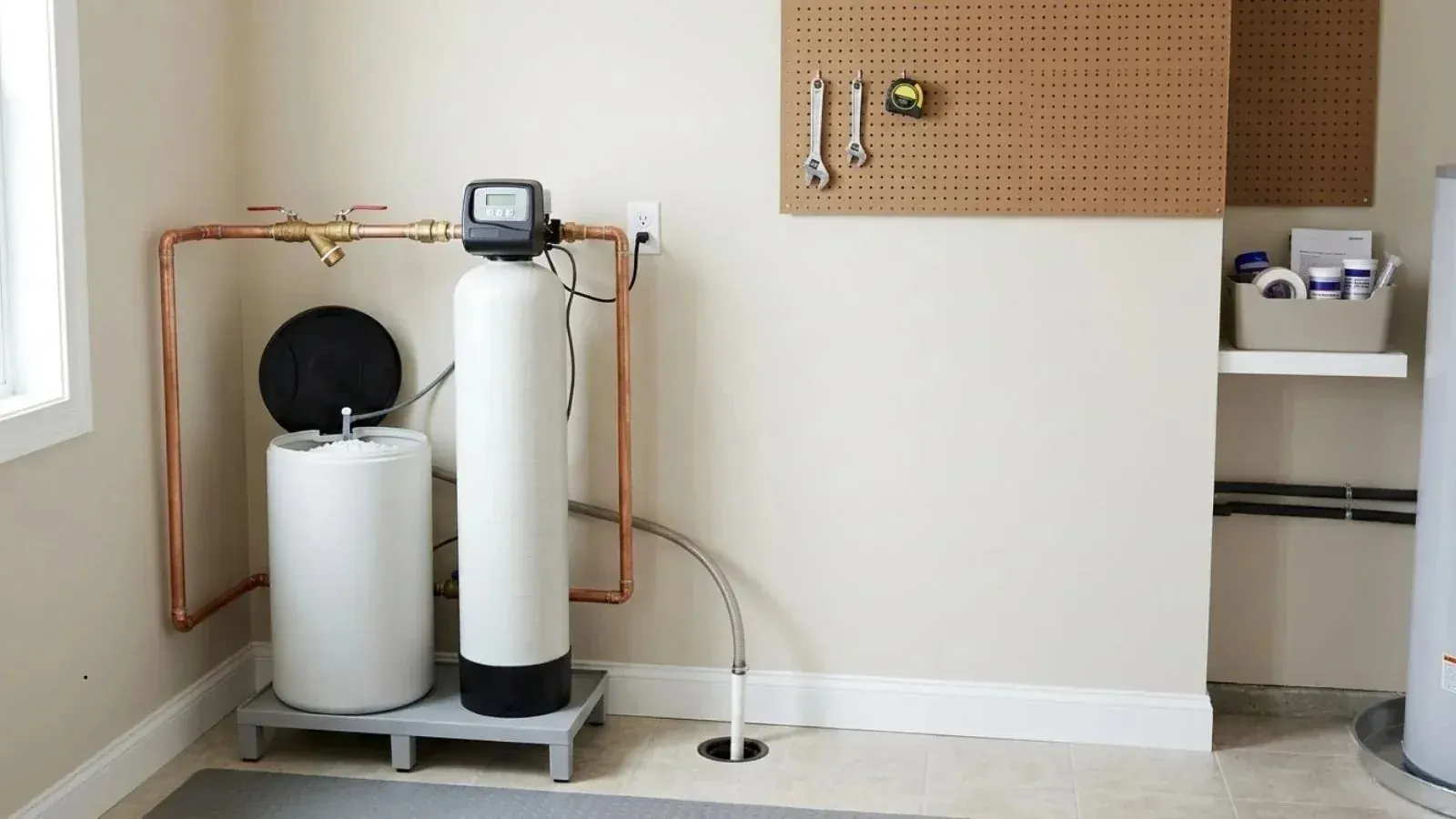
Water Softener and Filtration in San Juan Capistrano, CA
Hard water leaves spots, scale and short-lived appliances. We size, install and repair softeners and filters. Call (949) 325-3122.
Water Softener & Filtration: the 24/7 line is answered at every hour.
What is in the water coming to your house
Water softener and filtration service in San Juan Capistrano, CA starts with knowing which water you have. Santa Margarita Water District serves the city with a blend: local groundwater treated at the San Juan Groundwater Plant, water purchased from Irvine Ranch Water District and water from the Metropolitan Water District, which is imported from the Colorado River and State Water Project. The mix changes what comes out of your tap.
In the 2026 report (2025 data), total hardness averaged 210 mg/L, which is about 12 grains per gallon, and readings spread from 89 to 290 mg/L. Even the low end is moderately hard, and the swing from 5.2 to 17 grains means two neighbors can need different equipment. Test your own tap or ask SMWD Customer Care about your part of the system.
Sizing a softener from your grains
A softener is sized by how many grains of hardness your household uses between regenerations. Multiply daily water use by your hardness in grains per gallon. A family of four using about 75 gallons each at 12 grains faces roughly 3,600 grains a day, so a unit rated near 32,000 grains would regenerate about every nine days.
Too small a unit regenerates constantly and wastes salt and water. Too large a unit can sit idle so long that the resin gets stale. If your address leans toward the 17-grain end of the district's range, the same family needs a larger unit than a neighbor near 5 grains. Softener drain lines and bypass plumbing also fall under the California Plumbing Code, based on the Uniform Plumbing Code (UPC).
| Detail | What it changes |
|---|---|
| Number of people | Raises daily water use and grains per day. |
| Hardness at your tap | Raises grains per day, so sets the capacity you need. |
| Iron or other minerals | Can foul the resin and may call for a pre-filter. |
| Peak flow | Decides valve and pipe size, not just tank size. |
| Where the unit sits | Needs a drain, power outlet and a bypass nearby. |
Salt-based softener or salt-free conditioner
These two do different jobs. A salt-based softener swaps calcium and magnesium for sodium on a resin bed, so the water is genuinely soft. A salt-free conditioner changes how the minerals behave so they cling less to pipes, but the hardness number does not drop.
| Question | Salt-based softener | Salt-free conditioner |
|---|---|---|
| Hardness removed | Yes, measured in grains | No, minerals stay but stick less. |
| Spotting on glass and tile | Strongly reduced | Reduced less. |
| Maintenance | Refill salt, occasional resin and valve service | Media replaced on a schedule. |
| Drain and power needed | Yes | Usually none. |
| Best for | Heavy scale, soap lather, appliances | Light scale control where soft water is not required. |
At the district's 12-grain average, most households who want a real change in how water feels and how appliances age lean toward salt-based. Where salt use or discharge limits worry you, ask about alternatives before buying. Water heaters appreciate soft water too, and our tankless service page shows how scale affects them.
Where filtration fits
Filtration is a separate job from softening. A whole-house carbon filter takes out chlorine taste and odor, a sediment filter catches grit and an under-sink reverse osmosis unit polishes drinking water. Softeners do none of these things, so pair them according to what bothers you.
Decide by symptom. If glass is cloudy and showers feel filmy, you want softening. If water tastes or smells off, you want carbon. If you only care about drinking and cooking, a single tap-side filter may be enough.
Ready to deal with scale for good? Call (949) 325-3122 and we will start from your actual water.
What hard water looks like in the house
- White crust builds up on my faucets and showerheads.
- Dishes come out of the dishwasher with spots.
- Soap does not lather and my skin feels dry after showering.
- The water heater rumbles or my last one died early.
- Laundry feels stiff and towels look dull.
- Water pressure at showerheads is dropping slowly.
Water conditioner repair
Softeners fail in ordinary ways. Resin beads break down, the brine tank forms a salt bridge so no brine reaches the resin, the control valve sticks or the injector clogs. Water that suddenly turns hard, a unit running endlessly or a flooded brine tank usually points to one of these.
We check the salt level and bridge first, then run a manual regeneration and test hardness before and after. If a unit is beyond repair, we explain what the replacement should look like, sized from the numbers above. Salt-free conditioners need their media replaced on a schedule, and we handle that too.
What a softener or filter install costs, in factors
| Factor | Effect |
|---|---|
| Capacity and type | Salt-based, salt-free, carbon and reverse osmosis are priced separately. |
| Plumbing changes | Bypass, new shutoffs, drain line and electrical outlet. |
| Pipe material and condition | Corroded or awkward pipe adds labor at the tie-in. |
| Pre-filters and extras | Sediment filters or a bypass for outdoor taps. |
| Repair versus replacement | Valve and resin work costs less than a new unit. |
Homeowners insurance generally does not cover water treatment equipment as a repair, because hardness is a standing condition rather than sudden damage. Your insurer can answer for your policy. Want your real number? Call (949) 325-3122 and you will hear a clear price before work starts.
Where we set these up
We install and repair softeners across ZIP codes 92675 and 92693. Homes just north in Mission Viejo sit in the same district, so our Mission Viejo coverage follows the same hardness logic. When a tie-in needs new valves or a drain, it can fold into our plumbing installation work. A clogged or failing heater caused by scale can be handled by our water heater repair team, and urgent failures go to the 24/7 line.
Water Softener & Filtration questions, answered
Hard, by any measure. The district reported an average near 12 grains per gallon for 2025, and individual taps ran from about 5 to 17, so your own result may land well above or below that.
Multiply the household's daily water use by your grains per gallon, then choose a unit that regenerates every several days instead of every day. The plumber can run the math with a test of your tap.
Not by itself. Softeners remove hardness minerals. Carbon filtration addresses chlorine taste and odor, so people who want both install both.
It helps reduce scale buildup, but the water remains hard in the measured sense. If you want fewer spots and softer-feeling water, a salt-based system does more.
Common causes are an empty brine tank, a salt bridge, a worn resin bed, a stuck valve or an open bypass. A hardness test at the tap and a manual regeneration help narrow it down.
Usually yes, if there is space for the unit, a nearby drain and an outlet. Older pipe may need some updating at the connection point.
In most cases, yes. Tell the plumber the brand and symptoms when you call, and we will work out whether it is a repair or a replacement.
Need water softener & filtration in San Juan Capistrano? Call the 24/7 line.