
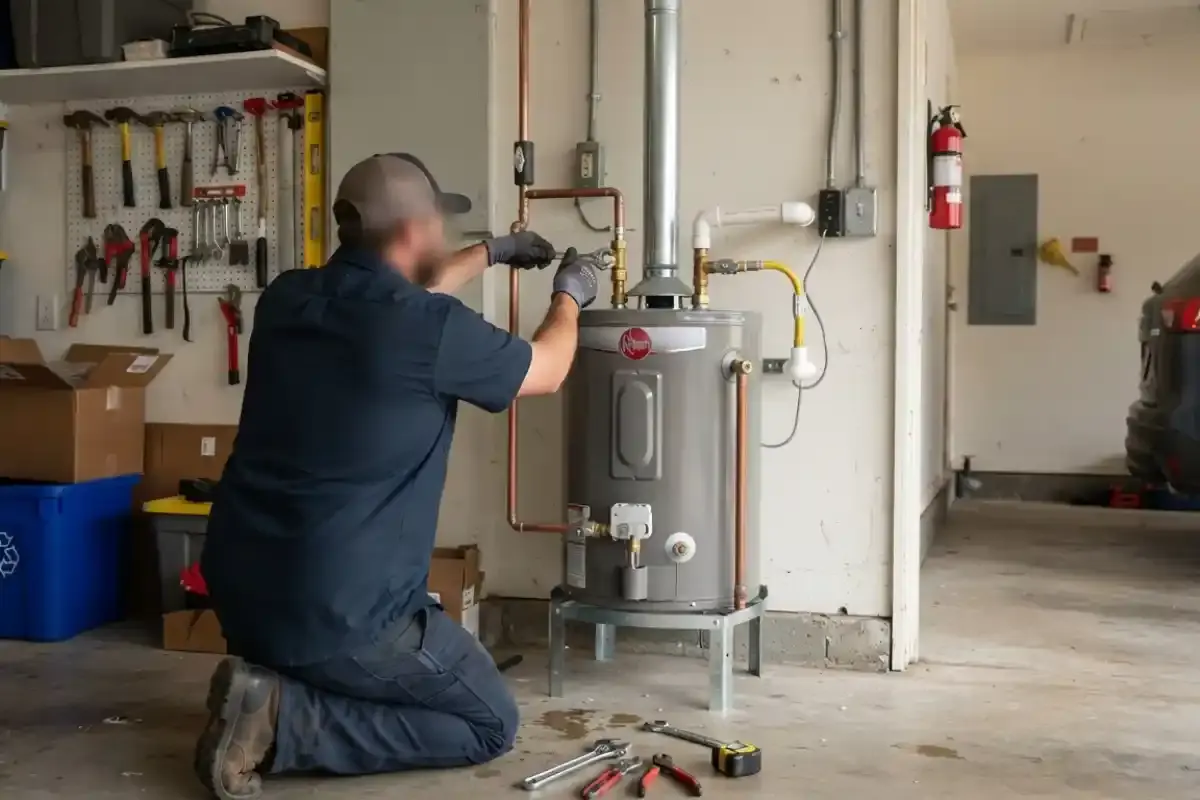
Water Heater Installation in San Juan Capistrano, CA
A well-planned install starts with the right size, a safe vent and a proper strap kit. Talk it through at (949) 325-3122.
Water Heater Installation: the 24/7 line is answered at every hour.
What a proper water heater install includes
Water heater installation in San Juan Capistrano, CA means choosing a unit that fits your household, setting it where it can be vented and serviced, and connecting water, fuel and safety devices to code. A good install is mostly decisions made before the old tank moves. Those decisions are covered below so you know what to ask.
If your current tank has already failed, emergency replacement is the faster route. This page is for planned work: a remodel, a new build, a move from gas to electric, or an upgrade you chose to do on your own timeline. Urgent failures still go to the 24/7 line at (949) 325-3122. The California Plumbing Code, built on the Uniform Plumbing Code (UPC), is the rulebook the plumber works from for relief valves, venting and gas connections.
Sizing: the household decides, not the closet
Tank size and recovery rate are two separate numbers. A 40-gallon tank with a fast burner can outperform a 50-gallon tank with a slow one in a busy morning. What matters is how many people shower close together, whether a soaking tub sits upstairs and how far the heater is from the farthest fixture.
| Situation | Sizing effect |
|---|---|
| Several showers in the same hour | Larger tank or higher recovery. |
| Large soaking tub or multiple body sprays | Larger tank, or a second heater near the bathroom. |
| Long pipe run from heater to bath | Consider recirculation or a closer location. |
| Two people, one bathroom | Smaller tank is fine and uses less standby energy. |
| Scale buildup in the tank over the years | Leave some margin, because sediment takes up capacity. |
That last row is local. Santa Margarita Water District reported a 2025 average hardness of 210 mg/L, about 12 grains per gallon, and the range ran to 290 mg/L. Scale piles up at the bottom of the tank and quietly shrinks the usable hot water, so we lean toward slightly more capacity instead of the bare minimum.
Venting, gas lines and combustion air
A gas heater needs a vent that pulls exhaust outdoors with the right rise and slope, plus enough combustion air in the room. A closet with a louvered door is not always enough once the burner is running. A cramped or sealed space may need a direct-vent or power-vent model.
The gas line matters as much as the vent. If the supply pipe is too small for the new burner, the heater starves at high demand. Electric models skip the vent but need a dedicated circuit sized to the elements, which is a job for the electrician if the panel is full.
The expansion tank most homes need
Water expands when it heats. In a house with a check valve or pressure regulator at the meter, that water has nowhere to go, so pressure spikes every time the heater fires. A small expansion tank on the cold line absorbs the swell and spares the T&P valve, fixtures and supply hoses.
Without one, you may see the relief valve dripping or washing machine hoses burst without any visible reason. We test your static pressure and check whether the system is closed, then set the expansion tank's air charge to match.
Not sure which size, fuel or vent setup fits your house? Call (949) 325-3122 before you buy the unit.
Straps, permits and the building department
Every tank in this state has to be braced or strapped so a quake cannot walk it off its base. Typically that is a strap near the top and another near the bottom, screwed into studs, or a kit made for that model. Skipping it risks a tipped heater ripping gas and water lines out of the wall.
Permit rules vary, so ask the San Juan Capistrano building department. We will describe the work involved so you can ask the right question.
Install day, step by step
- STEP 01
Walk the site.
The plumber looks at the heater location, vent route, gas or electrical capacity and shutoff valves.
- STEP 02
Prepare the space.
Water is shut off, the old unit is drained and removed, and the pad, pan or platform is set.
- STEP 03
Set and connect.
The new heater goes in, with supply lines, relief valve, discharge pipe, expansion tank and vent or wiring.
- STEP 04
Strap, fill and fire.
Straps go on, the tank fills with air bled out, then the unit is lit or powered and tested for leaks and temperature.
- STEP 05
Walkthrough.
You learn where the shutoffs are, how to read the temperature setting and when to flush the tank.
Signs it is time to book an install
- We are renovating and want the heater moved or upgraded.
- The family has grown and the hot water runs out halfway through the mornings.
- My tank is past ten years old and I would rather replace it on my terms.
- I want to switch from gas to electric, or add a heat pump unit.
- The heater sits in a hot attic and I want it moved somewhere easier to service.
- We bought the house and the inspector flagged the water heater setup.
What goes into the price
| Factor | Why it matters |
|---|---|
| Unit type and capacity | Tank, hybrid and tankless units are priced very differently. |
| Fuel and distribution work | New gas line, flue or a larger electric circuit adds labor. |
| Code items | Expansion tank, strap kit, pan and relief piping are added to the base install. |
| Location and access | Attic or crawl-space work takes longer than a garage floor. |
| Permit and inspection | Depends on what the building department requires. |
A voluntary upgrade is not sudden damage, so insurers rarely pay for it. If an old heater already leaked and you intend to claim, ask your insurer how they want the work documented. Want your real number? Call (949) 325-3122, and you will have a clear price before work starts.
Where we install
Our team installs in ZIP codes 92675 and 92693 and reaches the neighboring towns, including those on our Laguna Niguel page. If the project is part of a larger remodel with new lines or fixtures, our plumbing installation work covers the rest of the rough-in. Considering tankless instead of a tank? Our tankless service page explains that choice.
Water Heater Installation questions, answered
A like-for-like tank swap is usually a matter of hours. Moving the heater, changing fuel or adding venting stretches it, and the plumber can tell you when you describe the setup.
It depends on how many people live there and how many use hot water at the same time. Start with the household and the biggest bath, then adjust for tank sediment and distance to the fixtures.
Many homes do, especially if there is a pressure regulator or check valve on the incoming line. The plumber tests your pressure and checks the system before recommending one.
Often yes, but the vent path, gas supply and freeze exposure all matter. Freezing is rare here, though not impossible, so a protected spot still beats an exposed one.
Check with the city's building department before the date is set, as described above, since the answer can affect your schedule.
Yes. Property managers can describe the units on the phone, and installs can be scheduled one after another using the same specifications.
It can. Tank models handle it with regular flushing, while tankless units need descaling or a softener ahead of them. A short test of your water hardness helps you decide.
Need water heater installation in San Juan Capistrano? Call the 24/7 line.