
Tankless Water Heater Service in San Juan Capistrano, CA
Tankless units heat water on demand, and local water leaves scale inside them. We flush, repair and install them. Call (949) 325-3122.
Tankless Water Heater: the 24/7 line is answered at every hour.
How a tankless heater works and where it gets into trouble
Tankless water heater service in San Juan Capistrano, CA covers units that heat water only when a tap opens, with no stored tank. A flow sensor detects the draw, a burner or electric element fires and water passes through a heat exchanger on its way to the fixture. Because the exchanger is a narrow, tightly packed coil, anything that coats it hurts performance quickly.
Most trouble comes from three places: scale inside the exchanger, a clogged inlet filter and a venting or gas supply that was marginal from the start. If you already know your unit has stopped altogether, the 24/7 line at (949) 325-3122 handles urgent failures, and our heater repair page explains how we diagnose them.
Gas line sizing and vent runs for a tankless unit follow the California Plumbing Code, a UPC-based standard, so the plumber checks both before ordering a unit.
Flushing and descaling: the maintenance that hard water demands
Santa Margarita Water District measured 2025 hardness at an average of 210 mg/L, roughly 12 grains per gallon, and up to 290 mg/L in parts of the system. Every time that water is heated, calcium drops out and sticks to the hottest metal, which is the inside of a heat exchanger. A thin layer cuts flow, uneven heating follows and eventually the unit shuts down with an error code.
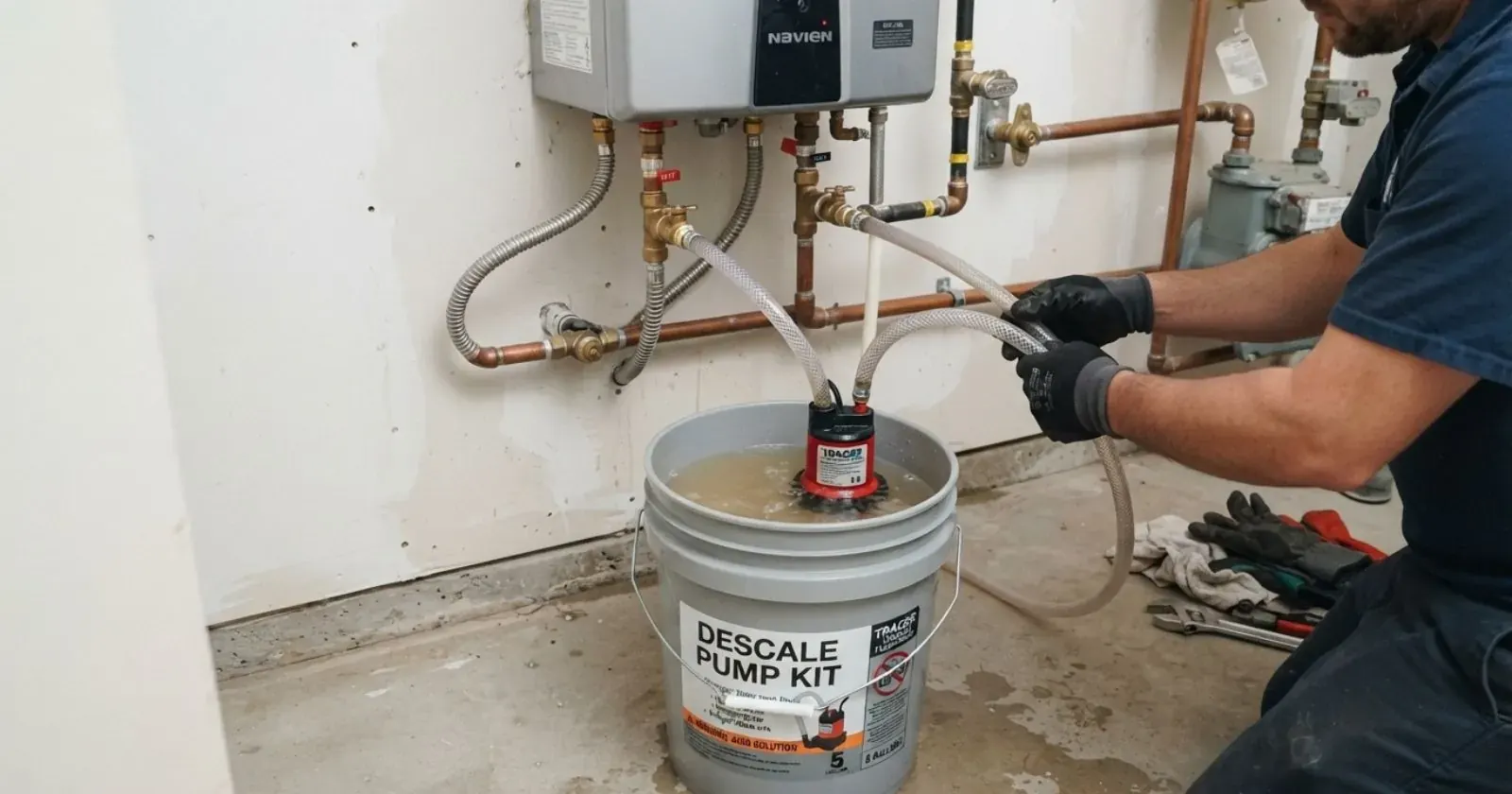
A descale flush circulates a mild acid solution through the exchanger using isolation valves and a small pump, then rinses it clean. Done on a regular schedule, it keeps the exchanger working near its original efficiency. Skipping it is the most common way a tankless unit dies young in a hard water area, so local owners should ask about flushing early and often.
- STEP 01
Isolate the unit.
Power and gas are shut off, then the water isolation valves are closed.
- STEP 02
Connect the pump.
Hoses link the service ports to a bucket and pump, with descaling solution in the loop.
- STEP 03
Circulate.
Solution runs through the exchanger long enough to dissolve the scale, which varies with the buildup.
- STEP 04
Rinse and clean the filter.
Fresh water flushes out the solution and loosened scale, and the inlet screen is cleaned.
- STEP 05
Restart and verify.
Valves reopen, gas and power return and the unit is checked for temperature rise and leaks.
Soften the water, soften the maintenance
A softener upstream of a tankless heater keeps most of the calcium out of the exchanger. It does not remove the need for checkups, but it stretches the time between flushes. See our softener and filtration page if that sounds worth pricing.
Signs your tankless heater needs attention
- The water goes lukewarm when I run two taps, and it was fine before.
- A fault code flashes on the display and the unit shuts down.
- I hear kettle-like noises, popping or whistling from the unit.
- Hot water takes longer to arrive than it used to.
- The hot temperature swings between scalding and cool.
- The unit has never been flushed and has been running for a few years.
Repairs beyond scale
Error codes narrow down the fault, though they are a starting point. Ignition failures often come from a dirty flame rod, a weak gas supply or a blocked vent. Flow sensors, thermistors and fans also wear out, and a power board can fail after a surge.
We read the code, then test the part rather than swapping several at once. If the exchanger is cracked or too scaled to clean, we will say so and explain what replacement would involve. Parts for some older models can be hard to find, which also changes the repair-or-replace decision.
If your tankless heater is running cold or throwing codes, call (949) 325-3122 and we will start with the exchanger.
Is a tankless heater right for your house?
| Question | Tank | Tankless |
|---|---|---|
| Hot water capacity | Limited by tank size, then recovers | Continuous, limited by flow rate. |
| Space | Needs a floor footprint | Mounts on a wall, often saving closet space. |
| Gas and vent needs | Standard vent and line | Larger gas line and special venting for most models. |
| Maintenance in hard water | Tank flushing, anode check | Regular descaling flushes. |
| Several fixtures at once | Handles it until the tank is empty | Can struggle if the unit is undersized. |
The deciding questions are gas line size, vent path and how many fixtures run together. A wall that cannot host the vent or a gas meter that cannot feed the burner changes the cost more than the unit itself. Our installation page covers sizing and venting in more detail.
Putting a tankless unit in
Installing a tankless heater usually means upsizing the gas line, adding a condensate drain for high-efficiency models and running new venting. Electric tankless units draw heavy current, so the panel and wiring need to carry it. Isolation valves go in at install, which makes later flushes simple.
Seismic bracing rules in California apply to tank heaters, while a tankless unit hangs on the wall and has to be anchored solidly to the framing.
What affects the cost of tankless work
| Factor | Effect on the job |
|---|---|
| Service or install | A flush is a short visit, an install is a multi-part project. |
| Unit capacity | Higher flow rating costs more. |
| Gas line, vent and electrical changes | Often the largest part of an install. |
| Scale level and last service | Heavy scale takes more time to dissolve. |
| Model and parts availability | Older or uncommon models can need special-order parts. |
Insurance usually treats scale damage and wear as maintenance, so it is not a covered loss. A sudden burst or flood from the unit is different, and your insurer can say what applies. Want your real number? Call (949) 325-3122 for a clear price before work starts.
Coverage
We service tankless heaters in ZIP codes 92675 and 92693, and our crews also reach customers who find us through the Rancho Santa Margarita page. Most calls here are scheduled, and urgent breakdowns go through the same 24/7 line.
Tankless Water Heater questions, answered
With hard water, most owners benefit from a flush about once a year, sometimes more often if the water is harder at their address. A softener can stretch the interval. Your plumber can set a schedule after seeing how scaled the unit is.
The plumber closes the isolation valves, connects a pump and hoses, circulates a descaling solution through the exchanger and rinses it out. It takes a short visit, and you have hot water again right afterward.
Codes can point to ignition, flow, temperature, venting or exchanger problems. Scale is a very common hidden cause, so a flush is often the first thing to try.
Rarely. Most houses need a bigger gas line, new venting or an upgraded electrical circuit. The plumber will check each of these on the site visit.
Yes, they make flushing quick and cheap. If your unit does not have them, they can be added during a service call.
It cuts scale a lot, but the unit still needs inspection, filter cleaning and occasional flushes. Ask about both together.
It can be, since it saves space and has no tank to fail. Landlords should weigh the gas line and venting cost against the lifespan, and plan descaling into the maintenance schedule.
Need tankless water heater in San Juan Capistrano? Call the 24/7 line.