
What Is a Plumbing Auger? San Juan Capistrano Homeowner Guide
An auger is a coiled steel cable on a crank that grabs or breaks up a clog. This guide covers the three types, which one fits which fixture, and how to use one without scarring your porcelain.
Water already escaping? Skip the reading and call.
An auger in plain words
A plumbing auger is a flexible steel cable with a corkscrew tip, turned by a hand crank or a motor. You feed the tip into a blocked drain, rotate it, and the tip either hooks the clog or bores a hole through it. Then you pull the cable back out or push the debris on its way.
The word covers three tools that look quite different: the closet auger for toilets, the drum or canister auger for sinks and tubs, and the power auger for heavier jobs. Choosing the wrong one is how people scratch toilet bowls and kink cables.
Closet auger: the toilet specialist
A closet auger is a short cable inside a rigid, curved tube with a handle on top. The tube guides the cable around the bend inside a toilet. A rubber or vinyl sleeve at the bottom of the tube keeps bare metal off the porcelain.
This is the tool for a toilet that flushes slowly, rises and then drains, or will not clear after a plunger fails. The curve matters, because a toilet's trap twists the path in a way a straight cable cannot follow.
- STEP 01
Protect the bowl.
Lay old towels around the base. Check that the rubber sleeve covers the tube end, with no bare metal visible.
- STEP 02
Seat the tip.
Pull the cable back into the tube, set the curved end into the drain opening, and push the tube until it settles.
- STEP 03
Crank and push.
Turn the handle clockwise while gently feeding cable forward. Stop if you feel hard resistance, since that may be a solid object.
- STEP 04
Pull back slowly.
Keep cranking as you retract the cable so the clog comes with it. Wipe the cable as it comes out.
- STEP 05
Test with water.
Flush once with a small amount first. If the bowl rises, shut the supply stop under the tank and stop.
Drum auger: sinks, tubs and short runs
A drum auger, sometimes called a canister auger, stores a longer cable inside a drum. You pull out as much cable as you need, lock it with a thumbscrew, and turn the drum's handle. It fits bathroom sinks, kitchen sinks, shower drains and tub overflows.
Most hair clogs in a bathroom sink sit just below the stopper, in the first stretch of pipe. A drum auger handles those easily. For a tub, many homeowners work through the overflow opening or after removing the stopper, depending on the design.
Bathroom sinks and showers usually clog from hair mixed with soap film. Kitchen sinks are different, because grease hardens in the pipe and the cable may only punch a hole through it. If the sink drains for a day and then backs up again, the hole closed over, and you need a full cleaning of that line. That is where our drain cleaning service comes in.
Power auger: when hand cranking runs out
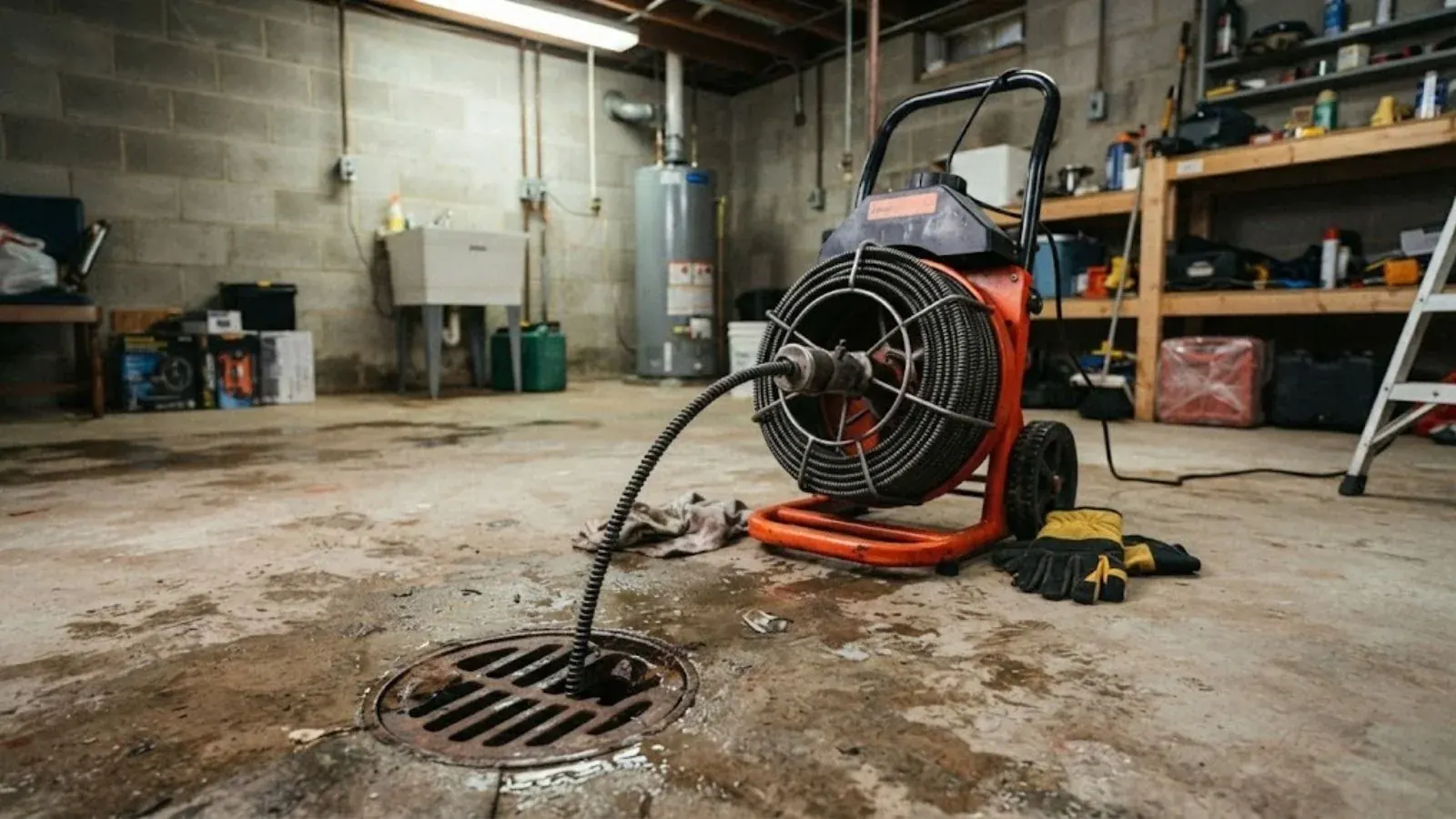
A power auger puts a motor on the drum or a larger cable machine. It spins faster and pushes further, which helps with dense blockages. It also puts more force on a pipe, so it is not a gentle tool.
Rental shops sell these to homeowners, but a tool this strong is easy to misuse. A cable that binds in a bend can twist back on the operator's hand, and a hard push can crack an old fitting. Many people who rent one end up calling for help anyway. For anything beyond a fixture trap, treat a power auger as a plumber's tool.
San Juan Capistrano note: hard water and toilet clogs
SMWD's 2026 Water Quality Report puts average hardness at 12 grains per gallon in 2025. That is hard water, and it leaves mineral scale on surfaces it touches. In a toilet, scale can narrow the small rim jets and roughen the bowl, so waste clings and flushes weakly.
An auger cannot clear a scaled rim jet, because it only reaches the trap. If your toilet flushes weakly but augering finds no clog, scale is a likely cause. A descaling treatment or a closer look at the fixture beats more cranking.
Source: SMWD 2026 Water Quality Report
Stuck cable or a clog that keeps coming back? Call us and we will sort out the next step.
Choosing the right auger
| Type | Best for | Avoid on |
|---|---|---|
| Closet auger | Toilets that are slow or fully blocked | Sinks and tubs, since the rigid tube will not fit. |
| Drum auger | Bathroom sinks, kitchen sinks, shower and tub drains | Toilets, where bare cable can scratch the bowl. |
| Power auger | Stubborn blockages beyond the fixture trap | Old or brittle pipe, and any drain you cannot see into. |
Protecting porcelain and chrome
Porcelain is hard, but it is not scratch proof. A bare metal tip dragging across a bowl leaves gray marks that are almost impossible to remove. Use a closet auger with a protective sleeve, and keep the handle steady so the tube does not swing.
For sinks, remove the P-trap and clear it by hand before you reach for the cable, since many clogs sit in that curve. Put a bucket underneath, because it holds a surprising amount of standing water. Never run a cable through a chrome tailpiece with force, or you will mar the finish.
- Wear gloves and eye protection, since clog material can spray.
- Check the rubber sleeve on a closet auger before each use.
- Never force a cable that refuses to turn.
- Stop if the cable comes back with water in the bowl and no debris.
- Do not mix drain chemicals with augering, since splashes can burn.
- Wash the cable and dry it before storing, to prevent rust.
When to stop and call
An auger is for a clog in a fixture or its first few feet of pipe. If several fixtures back up together, or a floor drain gurgles when you flush, the blockage is further down the line. That is a different job for a different machine, and more cranking at the toilet will not help.
A toilet that clears and then blocks again within a day is another warning. A foreign object, a cracked trap or a broken seal may be the real cause. Call (949) 325-3122 and describe what happened, and we will tell you whether it sounds like a quick fixture job or something that needs a closer look.
If the toilet needs to come off the floor for service, our toilet repair and installation team can handle the removal and reset. Towns near us, such as Dana Point and San Clemente, follow the same advice.
What affects the cost of an auger visit
A plumber's price depends on which fixture is blocked, whether the toilet must be pulled, and how stubborn the blockage turns out to be. The type of obstruction matters too, since a wad of paper is easier than a toy. Access under the sink and the age of the fixture also change the time on site. You hear the price before work starts, and same-day appointments are available when the schedule allows. Call (949) 325-3122 to book one.
Questions readers ask about this topic
No. The rigid tube is built for a toilet's curved trap and will not fit in a sink drain. Use a drum auger for sinks, and remove the trap first if you can.
Not if you use a closet auger with an intact rubber sleeve and let the tube guide the cable. Damage comes from bare cable scraping the bowl or from forcing a stuck cable.
If anything feels wrong, stop and call (949) 325-3122 before it gets worse.
Typical homeowner drum augers hold a modest length of cable, enough for a sink trap and the first stretch of branch line. They are not made for the main sewer line. If the blockage is further out, a longer machine is needed.
A repeat clog usually means something is still in the trap, or the toilet has a flow problem such as a scaled rim. In San Juan Capistrano's hard water, scale is a real possibility. A plumber can check the bowl and test the flush.
Avoid it. Cleaner left in the pipe can splash on you when the cable disturbs the clog. If you used a chemical, tell whoever works on the drain next.
Done reading and still have water where it should not be? Call now.