
Tankless Water Heater Guide for San Juan Capistrano, CA
A tankless heater can suit a San Juan Capistrano home, but local hard water decides how much upkeep it needs. This guide covers scale, flow rate, descaling and what lifespan claims really mean.
Water already escaping? Skip the reading and call.
Does a tankless heater work with hard water
Yes, a tankless water heater works in a hard water area, but it needs scale control to stay efficient. It heats water on demand as it flows through a narrow heat exchanger, and narrow passages are exactly where minerals collect. Around San Juan Capistrano, average hardness runs about 12 grains per gallon, so plan on regular descaling or a softener.
Ignore that, and the unit slowly loses output, throws error codes and runs hotter than it should. Keep up with it, and the unit can serve a household for years. The tankless water heater team can size and install one, and the 24/7 line is (949) 325-3122 if your current heater quits.
How scale builds inside the heat exchanger
Hard water carries dissolved calcium and magnesium. When water is heated, some of it drops out as a hard crust on the hottest metal surface. In a tank, that crust settles at the bottom. In a tankless unit, it coats the very surface that moves heat into the water.
A coated exchanger has to burn longer to reach the set temperature, and it can overheat the metal beneath the scale. Flow also drops, because the passages narrow. You feel this as weaker hot water and longer waits, long before anything fails outright.
Scale also fouls the small filter screen at the cold inlet and can stick the flow sensor. Those two parts are cheap compared with an exchanger, so cleaning them is worth doing even between full descaling visits.
If an error code points to overheating or low flow, do not keep resetting the unit. Repeated resets hide a scale problem that is getting worse. Have the exchanger inspected before the repair turns into a replacement.
Flow rate: what one unit can really feed
Every tankless heater has a maximum flow, measured in gallons per minute, at a given temperature rise. Rise is the gap between incoming water temperature and your hot setting. A bigger rise or more fixtures at once means less flow before the heater runs out of capacity.
| What is running | Load on the unit | What you notice |
|---|---|---|
| One shower | Light | Steady heat. |
| Shower plus dishwasher | Moderate | Fine on a well-sized unit. |
| Two showers and laundry | Heavy | Water may cool or flow may drop. |
| Several fixtures with a tight unit | Beyond capacity | Temperature swings, shutoffs or error codes. |
Size the unit for your busiest moment, not a quiet morning. Some homes pair two smaller units or add a recirculation setup so the first shower is not a long wait.
Want a straight answer on whether tankless fits your household? Call and talk it through.
Descaling a tankless heater, step by step
- STEP 01
Power down and isolate.
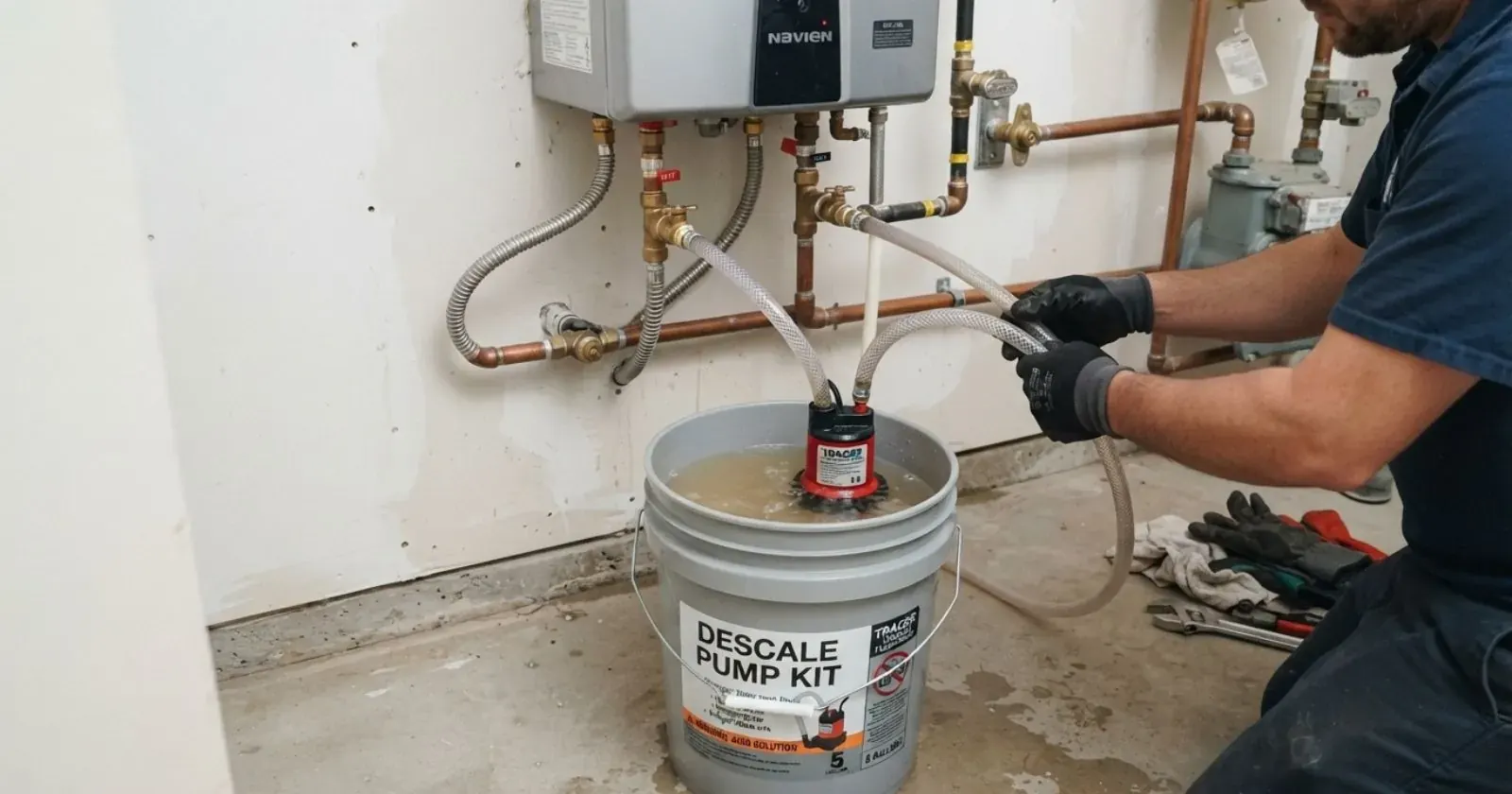
Turn off the gas or power. Close the isolation valves on the hot and cold lines, which many installers fit for this purpose.
- STEP 02
Hook up the pump.
Connect a small circulating pump and two hoses to the service ports, with the other ends in a bucket of descaling solution. White vinegar is common, but follow your unit's manual.
- STEP 03
Circulate.
Run the solution through for the time your manufacturer calls for. Do not shortcut this, since thin scale layers can take a while to dissolve.
- STEP 04
Flush and clean the screen.
Rinse with clean water, pull and wash the inlet filter screen, then reopen the valves and restore power or gas.
- STEP 05
Test.
Run hot water for a few minutes and watch for leaks, steady temperature and clean error history.
How often depends on how hard the water is and how much hot water you draw. Harder water and bigger households mean shorter gaps. Your manual and a plumber who has seen your exchanger are better guides than a calendar.
San Juan Capistrano note: the hardness figures behind the advice
Since November 2021, Santa Margarita Water District has run the city's water service. Its 2026 Water Quality Report, covering 2025, puts total hardness in the system at an average of 210 mg/L as calcium carbonate, about 12 grains per gallon. For a tankless owner, that is hard water, and descaling belongs on the calendar.
Readings ranged from 89 to 290 mg/L, or about 5.2 to 17 grains per gallon, depending on where you are in the system. Your street may sit at either end. Read the report or test your own tap before picking a descaling schedule, and call SMWD Customer Care at 949-459-6420 if you want to ask where your address falls.
Source: Santa Margarita Water District quality report for 2025
Gas line and venting: settle these before you buy
A tankless burner needs a lot of gas at once, more than most tank burners. If the existing gas line was sized for a tank heater, it may need upgrading, and that can change the whole project. Venting also differs, since many models need sealed, special-material vent runs.
Ask for both items to be named in the quote. A clear price before work starts should include them, and it should say whether the exchanger is protected by a softener.
How to read lifespan claims
Makers often advertise a longer life for tankless units than for tanks. That figure usually assumes steady maintenance and decent water quality. In hard water without descaling, a unit can fall short of it, and warranty terms may require proof of service.
Warranty wording is worth reading closely. Some makers ask for proof of descaling or water treatment, and a few limit coverage on the heat exchanger when hard water is involved. Keep service records, and ask the installer to point out the isolation valves so you know they exist.
- Hot water arrives slowly or turns lukewarm mid-shower.
- The unit shows the same error code more than once.
- You hear popping or rumbling while it fires.
- The inlet screen is crusted with white or gray flakes.
- Your gas use climbs while hot water output feels weaker.
Softener or filter: what actually protects it
A water softener removes the minerals that cause scale before they reach the heater. A plain filter does not. If you want fewer descaling visits and cleaner fixtures, ask about softening options and pair it with a hardness test at your own tap.
Check where your water comes from. Laguna Niguel is served by Moulton Niguel Water District, so its numbers differ from SMWD's, and Laguna Niguel homeowners should look at their own utility's report. San Clemente's Talega community is inside SMWD's service area, so San Clemente owners there can use the same figures.
Cost factors include unit size, gas line work, vent run length, added valves, a softener and access. Want your real number? Call (949) 325-3122.
Questions readers ask about this topic
There is no single interval. In water this hard, many owners schedule a descaling visit about once a year, then adjust based on what the inlet screen and error history show. Follow your manufacturer's instructions, and call (949) 325-3122 if you would rather have a plumber do it.
Many owners do it with a small pump, hoses and descaling solution if isolation valves are installed. If your unit lacks service ports, or you are uneasy near gas, have a plumber do it.
No. It heats continuously, but only up to its rated flow. Run too many fixtures at once and the temperature drops or the unit limits flow.
Often the answer is a check, then maybe an upgrade. Tankless burners draw more gas at once, so the line size and length need to be confirmed before installation.
Terms differ by maker. Some warranties exclude scale damage or ask for proof of maintenance. Read your paperwork and ask the installer before you sign.
Done reading and still have water where it should not be? Call now.