
Tankless Gas Water Heater Pros and Cons: San Juan Capistrano
A gas tankless heater never runs out of hot water, but it brings gas line, venting and drain requirements a tank does not. Here are the real pros and cons for San Juan Capistrano homes.
Water already escaping? Skip the reading and call.
The short version: what you gain and what you take on
A gas tankless heater gives you hot water on demand with no tank to run out, takes less wall space and avoids heating water all day. In exchange, it costs more up front, often needs a bigger gas line and special venting, and asks for regular upkeep. It suits some households very well and others not at all.
The decision usually turns on three things: whether your gas line can feed it, whether a vent route exists, and how many fixtures run at once. This post is about those trade-offs. If you want help matching a model to your house, a plumber can walk through tankless water heater options with you.
Pros that matter in a real house
- Hot water does not run out during a long shower or a stack of laundry.
- A wall-mounted unit frees floor space where a tank used to sit.
- No standby loss, since the burner fires only when water flows.
- A well-maintained unit often outlasts a tank.
- A leak in the heater itself usually does not dump a whole tank.
The first pro is the one people feel. The unit heats water as it passes through, so a long shower does not drain a reserve. The limit is flow rate, not volume, which is the point we turn to next.
Cons that surprise people
A tankless heater fires a much bigger burner than a tank, so it needs more gas at once. An existing line sized for a tank may be too small, and upsizing it can mean opening walls or trenching. Ask the installer to size the line before you choose a model.
The vent is the second surprise. Condensing models pull heat from the exhaust and use plastic vent pipe with a sloped run, while non-condensing models use metal vent pipe that can be costly to reroute. Either way, the path to the outdoors has to exist, and the termination has to sit clear of windows and openings.
Third, there is flow rate. Run two showers and the dishwasher together and a unit sized for one shower will deliver lukewarm water. Size the unit to the most you will run at once, not the average. Fourth, a gas tankless still needs electric power, so a power outage can leave you without hot water.
Condensate, efficiency and what the drain is for
Condensing units produce acidic condensate as they cool the exhaust. That liquid must drain to a suitable place, often through a neutralizer, which is a small cartridge that raises its pH. Skipping this step eats at drain pipes.
Efficiency claims need a careful read. A tankless saves the standby heat a tank loses, but real savings depend on how much hot water you use, and a house that draws small amounts often can see less benefit than a house with heavy use. A plumber can help you compare the manufacturer's rating with your actual routine.
San Juan Capistrano note: a mild climate helps, but not for everything
San Juan Capistrano has a mean daily high of about 71 F and a mean daily low of about 56 F, and hard freezes are rare. That is good news for a gas tankless, since incoming water is rarely bitterly cold and exposed lines are less likely to freeze. Rare is not never, so an outdoor unit still needs freeze protection in its manual.
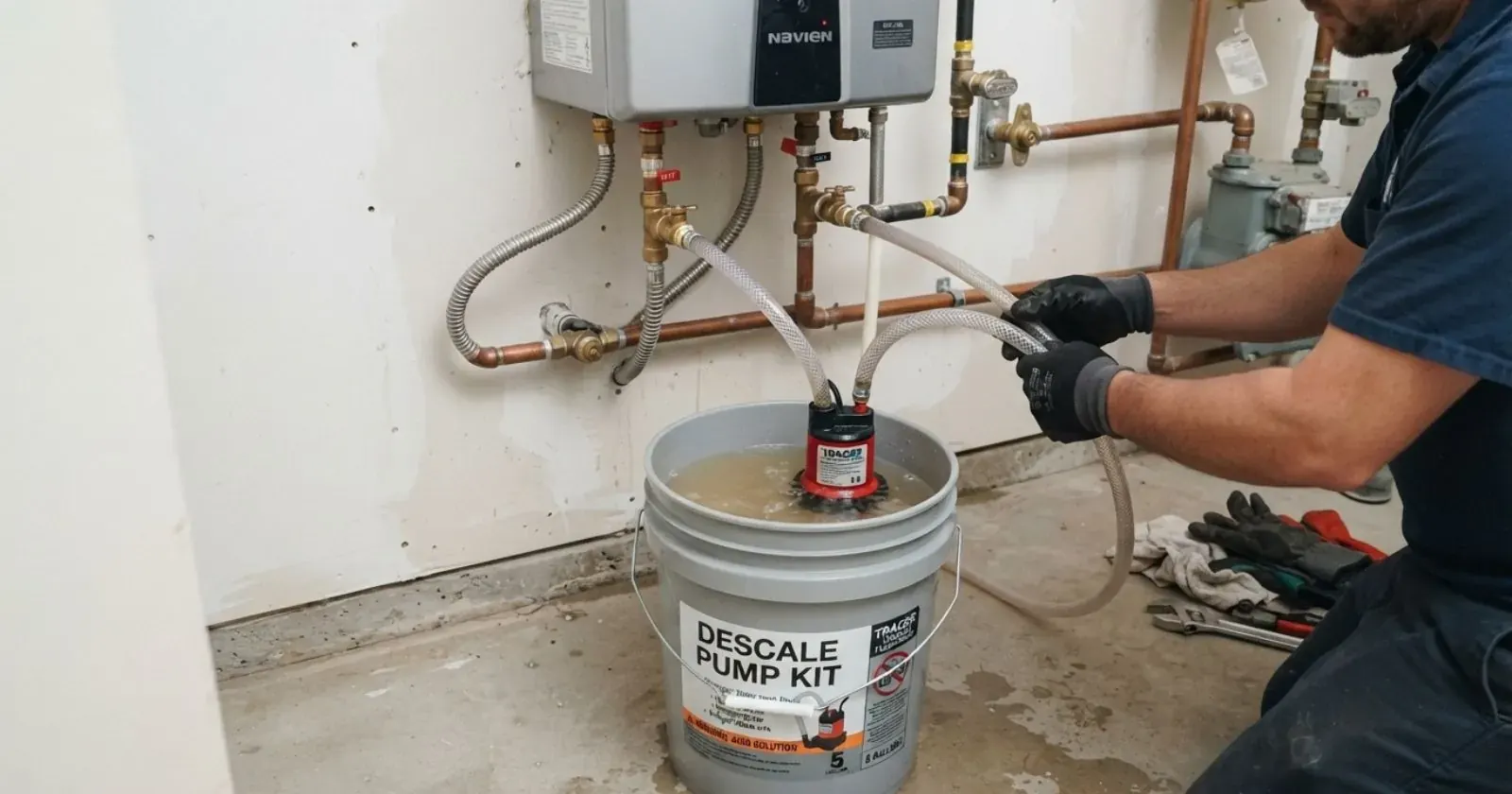
The water side is less forgiving. Hardness in the 2026 Santa Margarita Water District report for 2025 averaged 210 mg/L, or 12 grains per gallon, and up to 17 grains in some parts of the system. A tankless heat exchanger collects that scale on its narrow passages, so budget for descaling and ask about a softener before you buy.
Source: San Juan Capistrano climate facts and SMWD 2026 Water Quality Report (2025 data)
Weighing a tankless against a tank? Call (949) 325-3122 and talk through your gas line and vent path.
Tank versus gas tankless at a glance
| Factor | Tank heater | Gas tankless |
|---|---|---|
| Up-front installed cost | Lower | Higher, especially with a gas line or vent change. |
| Hot water supply | Limited by tank size | Limited by flow rate. |
| Footprint | Floor space needed | Wall-mounted, small. |
| Venting | Standard flue | Special vent, sloped, sealed joints. |
| Maintenance | Flush now and then | Descale on a schedule, keep condensate path clear. |
| Power outage | May still work on a gas pilot | Needs electricity to run. |
Neither is better in every house. A tank wins when the budget is tight and the layout is simple. Tankless wins when space, long showers or long-term use matter more.
Who a gas tankless fits
It fits a household that plans to stay put, has a gas line that can be upsized without tearing the house apart, and has a clear vent path. It also fits people tired of cold showers after a big family morning. It fits poorly where the gas meter is far away, the vent run is long, or the budget leaves no room for a surprise.
Before you buy, ask a few direct questions of whoever bids the job. Good installers answer them with numbers from your house, not from a brochure.
- Is my existing gas line big enough, and what does upsizing involve?
- Where will the vent run, and what does the termination look like?
- How will the condensate drain and be neutralized?
- What flow rate does this unit deliver at our water temperature?
- How often will it need descaling, and who does that?
What changes the price of a tankless installation
Cost factors include the unit size and brand, gas line upsizing and the vent route and material. The condensate drain and any water treatment to protect the heat exchanger count too. So do a new electric outlet and the removal of the old tank. Permits and inspection fees depend on your address.
Because so many of these depend on your house, a price quoted over the phone without a look is only a range of possibilities. For a clear price before work starts, call (949) 325-3122. The same crew covers water heater installation for tank swaps if you decide a tankless is not worth the extras.
Coastal and inland differences nearby
Outdoor-mounted units and vent terminations near the coast face salt air, which is a general corrosion factor for exposed fittings. In Dana Point, that is worth asking about if your unit will sit outside or its vent will pass through an exterior wall.
Farther inland in San Clemente, where downtown has older Spanish Colonial Revival buildings, the larger issue is usually fitting a vent into an existing wall. Either way, the installer should check clearances before ordering the unit.
Questions readers ask about this topic
It can be, when you have steady hot-water demand, a gas line that can be upgraded and a clear vent path. If your budget is tight or your venting would be difficult, a tank heater often makes more sense.
Often yes. The burner demands more gas at once than a tank burner does. A plumber sizes the line based on the unit and the length of the run.
Condensing tankless units cool the exhaust so much that water vapor condenses into acidic liquid. That liquid has to drain away safely, usually through a neutralizer, rather than sit in the unit.
Many owners add one or plan regular descaling, since average hardness is 12 grains per gallon. Ask the installer how your model handles scale and what the maker requires for warranty upkeep.
Check that power and gas are on and look for an error code on the unit. If it will not restart, call (949) 325-3122. The line is staffed 24/7, with same-day appointments when available.
Done reading and still have water where it should not be? Call now.