
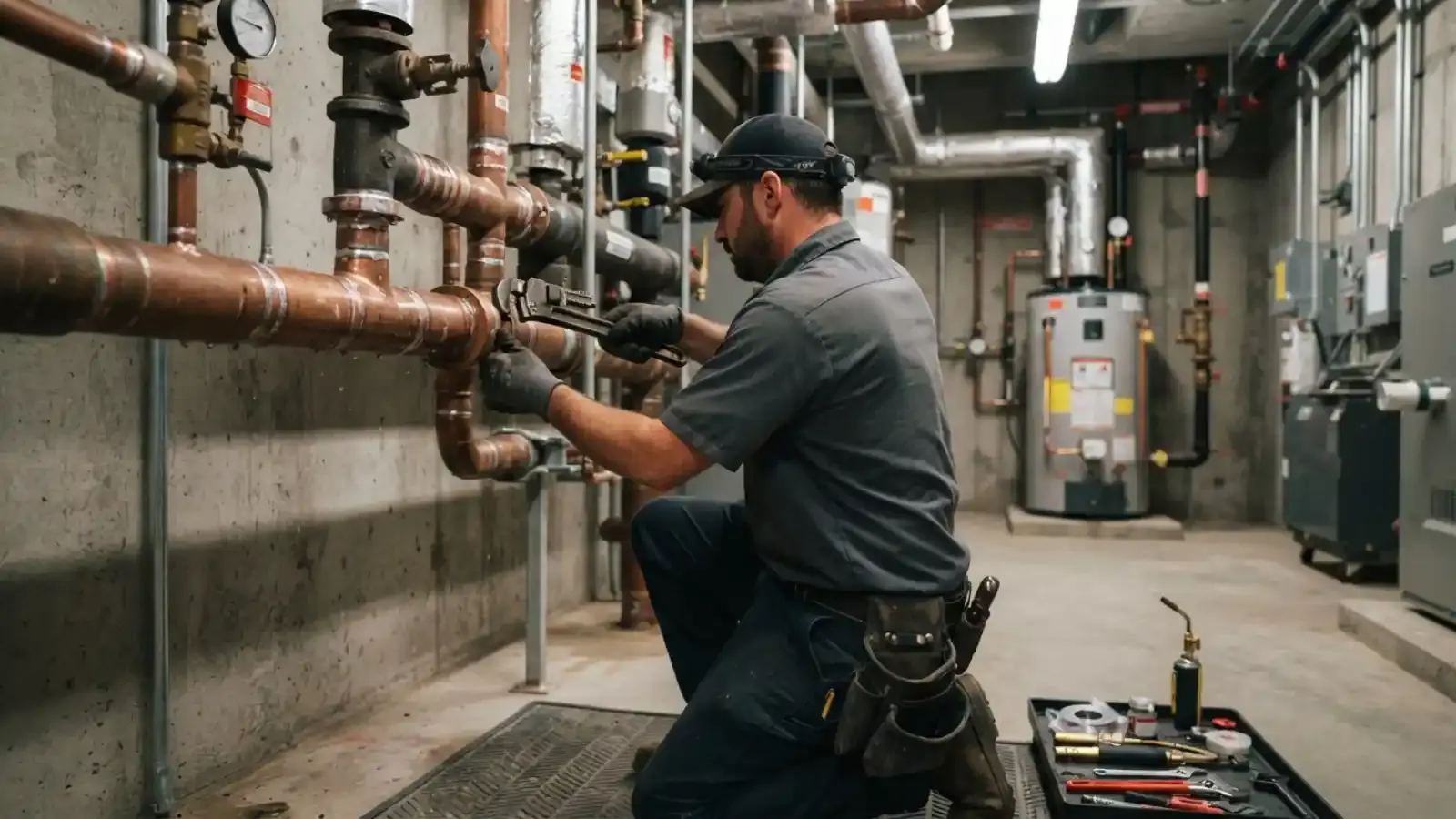
Stainless Steel Plumbing Pipe in San Juan Capistrano, CA
Stainless steel pipe is strong and corrosion resistant, but most houses never need it. Here is where it earns its place, how it compares with copper, PEX and CPVC, and what hard water does to it.
Water already escaping? Skip the reading and call.
Short answer: great pipe, rarely the right pick for a house
Stainless steel plumbing pipe is an alloy tube that resists rust and handles heat, pressure and harsh water better than plain steel. It shows up in commercial kitchens, labs, food and drink plants and some custom projects. For a typical home in San Juan Capistrano, copper or PEX does the job for less money and less fuss.
That does not make stainless a bad idea. It is a fit for specific problems, and knowing which ones keeps you from paying for strength you will never use. If you are weighing a whole-house repiping job, a plumber can lay out the choices on the 24/7 line at (949) 325-3122.
Where stainless pipe actually gets used
Food service is the classic home for it, because the metal is clean, smooth and easy to sanitize. Stainless also turns up in industrial water systems, hospitals, boiler rooms, outdoor exposed runs and places where a leak would be very costly. Some press-fit systems let installers join stainless tube without soldering.
In houses it is rare. You might see it as short exposed runs, as braided supply lines or as a drainage part in a custom kitchen. A homeowner who wants it for a whole house is usually buying looks or reassurance, not solving a plumbing problem.
Stainless, copper, PEX and CPVC side by side
| Material | Strengths | Trade-offs |
|---|---|---|
| Stainless steel | Very durable, handles heat and pressure, clean surface | Costly to buy and install, needs skilled fitting, can still pit in some water. |
| Copper | Long track record, handles heat, widely understood | Can pit or thin in aggressive water, price and labor are higher than plastics. |
| PEX | Flexible, fewer fittings, quick to install, tolerates movement | Not for sun exposure, fittings can restrict flow. |
| CPVC | Rigid plastic, simple glued joints, never rusts | Can turn brittle with age and heat, needs support. |
No material wins everywhere. The right choice depends on your water, your layout, whether lines run in open attic space or in finished walls, and what your plumber is licensed and comfortable installing.
Corrosion and hard water: what stainless fixes and what it does not
Stainless resists rust because it forms a thin protective layer on its surface. That helps against many forms of corrosion. It does not stop hard water from depositing mineral scale, which can build up inside any pipe or fixture over time.
Some stainless grades can also pit when exposed to salt or chloride-rich conditions. Marine environments are the usual concern, which is why the grade matters. A plumber can match the alloy to the setting, and a water test tells you more than a brochure.
In other words, if your problem is scale, a softener helps more than a pricier pipe. If your problem is leaking pinholes in old pipe, replacement helps, but the replacement does not have to be stainless.
San Juan Capistrano note: historic buildings and older pipework
Los Rios Street Historic District, addresses 31600 to 31921, was listed on the National Register of Historic Places on April 4, 1983. It holds 31 listed buildings and is called the oldest residential neighborhood in California. If you own one of these, ask the San Juan Capistrano building department what is allowed before changing visible pipework.
Most of the original adobes were replaced by wooden board-and-batten buildings in the 19th century. In an older wood building, the practical question is what the pipe is joined to and how it is supported. A premium pipe does not help if the framing, fittings or connections around it are tired.
Source: National Register listing facts for Los Rios Street, Dana Point coastal note
Unsure which pipe suits your house? Call and talk through the options before you commit.
What drives the cost
- The pipe itself, which is the most expensive of the four options.
- Fittings and joining method, since press tools or specialized welding raise labor.
- Access, such as open framing versus finished walls and slabs.
- The size and length of the system and how many fixtures it feeds.
- Permits and inspections, which vary, so ask the San Juan Capistrano building department.
Be wary of any pitch that treats stainless as a cure for every water problem. Ask what the pipe will fix in your house, in plain terms, and what it will leave alone. A good answer names the leak, the taste issue or the exposure risk and then explains why this material answers it.
A plumber who prices stainless fairly will explain why it costs more and where you truly benefit. Want your real number? Call (949) 325-3122.
Installing stainless: why skill matters
Stainless is harder to cut, bend and join than copper or PEX. Press fittings need the right tool and clean, square cuts, and a poor joint can leak even though the pipe is perfect. Welded or threaded systems demand more training still.
That is one more reason the pipe is uncommon in homes. Fewer installers handle it daily, so labor can run longer, and a repair years later may need the same specialty tools. Ask who will service it before you pick it.
Pressure and temperature ratings also depend on the fitting system, not just the pipe. Check that the fittings, seals and any valves are rated for hot water use, and that the manufacturer's installation instructions are followed to the letter.
Questions to settle before choosing
- What problem am I trying to solve: leaks, taste, scale or appearance?
- Have I tested my water and checked what is wrong with the current pipe?
- Will exposed runs matter for looks or code?
- Does my installer have experience with the system I am considering?
- Would a softener or a different material solve this for less?
Most answers point to copper or PEX for a typical house. Stainless fits when something unusual is going on, like a commercial-style kitchen or a very corrosive setup. If you are adding fixtures or lines, plumbing installation is where material choice gets made.
What neighbors elsewhere are choosing
Coastal homes see more corrosion pressure than inland ones. In Dana Point, salt air near the coast is a general corrosion factor for exposed fittings, so material and coating choices matter outdoors. That is a reason to ask about the alloy grade, not a reason to put stainless behind every wall.
Mission Viejo is a planned community, and much of it was complete by 1980. Mission Viejo owners are usually asking about the age and condition of existing pipe, not exotic materials. A camera, a pressure test and an honest look at the old piping come first.
Questions readers ask about this topic
It is stronger in some conditions and costs more. Copper has a long history in homes and works for most. Stainless usually makes sense only for special situations.
No. Scale comes from hard water, not the pipe material. A softener or treatment addresses the cause, and the pipe choice does not change it.
It can, but dissimilar metals need the right fittings. Direct contact between certain metals can speed corrosion, so ask your plumber about dielectric connectors.
Possibly, but rules for historic properties vary. Ask the San Juan Capistrano building department before you plan work, and have a plumber assess the existing pipe.
Look for pinhole leaks, rust-colored water, weak pressure and repeated repairs on the same line. A plumber can test the system and tell you whether repair or a full repipe makes sense. Call (949) 325-3122 to start that conversation.
Done reading and still have water where it should not be? Call now.