
How to Detect a Water Leak in San Juan Capistrano, CA
You can find most leaks with a quiet house, a flashlight and about an hour. This guide walks through the meter check, the dye test, the wet spots and the sounds that give a leak away.
Water already escaping? Skip the reading and call.
A leak hunt you can finish tonight
To detect a water leak, make the house use no water, then see whether anything still moves. Turn off every tap, appliance and irrigation timer, look at the water meter, and wait. If the dial or the low-flow indicator keeps turning, water is escaping somewhere. Then you narrow it down: toilets, fixtures, the water heater, outdoor lines, and finally the hidden pipes.
Most leaks turn out to be a toilet or an irrigation line, which you can fix or isolate yourself. If the trail leads into a wall, floor or the ground, a pro with the right gear saves you from cutting open the wrong spot. The leak detection crew is on the 24/7 line at (949) 325-3122 for exactly that.
Step one: the quiet house meter check
- STEP 01
Make the house silent.
Shut off taps, close the dishwasher and washer, pause the ice maker if you can, and stop irrigation. Nobody flushes during the test.
- STEP 02
Find the meter.
It sits in a box near the street or curb, often under a lid you can lift with a screwdriver. Brush off dirt and read the numbers.
- STEP 03
Watch the low-flow indicator.
Many meters have a small triangle or dial that spins with even a trickle. If it moves with everything off, you have a leak.
- STEP 04
Confirm with time.
Write down the reading, wait an hour or two without using water, and read again. Any change confirms the loss.
Step two: the toilet dye test
Toilets are the most common silent leak. Put a few drops of food coloring in each tank, do not flush, and wait about fifteen minutes. Color in the bowl means the flapper is leaking.
Test every toilet in the house, including the one nobody uses. A guest bathroom toilet can leak for months because no one hears it.
If the tank stays clear but you still suspect a toilet, check the fill valve too. A valve that hisses constantly can leak into the overflow tube without any color showing in the bowl.
Step three: walk the house for clues
| Clue | What it suggests | Check next |
|---|---|---|
| Damp cabinet floor under a sink | Supply line, trap or faucet base | Dry it, then look again an hour later. |
| Brown stain spreading on a ceiling | Pipe or drain above, or a roof leak | Check the room above and the attic. |
| Bubbling paint or soft baseboards | Moisture inside the wall | Feel along the wall, look for a pattern. |
| Musty smell in a closet or garage | Slow leak near a heater or pipe | Inspect the water heater base and pan. |
| Green or soggy strip outdoors in dry weather | Irrigation or buried supply line | Close irrigation valves and recheck the meter. |
Touch matters as much as sight. Run a dry hand along pipes under sinks, behind the toilet and around the water heater. A cold, wet fitting is easy to miss by eye but obvious by feel.
San Juan Capistrano note: dry weather makes wet spots stand out
The city gets about 13.6 inches of rain a year, so lawns and soil are normally dry for much of the year. A soggy patch, a green strip or standing water when it has not rained is therefore more likely a pipe or irrigation problem than the weather. Compare it to your watering schedule before blaming rain.
Mild temperatures also mean exposed lines outside are not usually frozen or burst by cold. Hard freezes are rare here, so a sudden outdoor puddle is likelier to be wear, a fitting or a sprinkler break. That is useful when you decide which valve to close first.
Source: city climate figures
Meter still moving and nothing in sight? Call and describe what the dial is doing.
Step four: listen after dark
When the house goes quiet, leaks become audible. Stand near the water heater, the main valve and each bathroom with the lights off. A faint hiss, tick or trickle where nothing is running is worth tracking.
Do a second listen with the main valve closed. If the sound stops, it is pressurized water, which narrows the source to the house piping. If it keeps going, you might be hearing a drain or an appliance instead.
Appliances, the heater and the yard
Several leaks hide in plain sight around machines. Pull the washer out an inch and look at the hoses and the wall box. Check the dishwasher's supply line and the ice maker tube, then the water heater's relief valve pipe and the floor around its base.
Outside, run your hand over hose bibs and look at the ground near the meter and along the foundation. Switch irrigation to manual, close its valve, and recheck the meter. If the dial now stops, the sprinkler system was your leak.
Which tool a pro uses and why
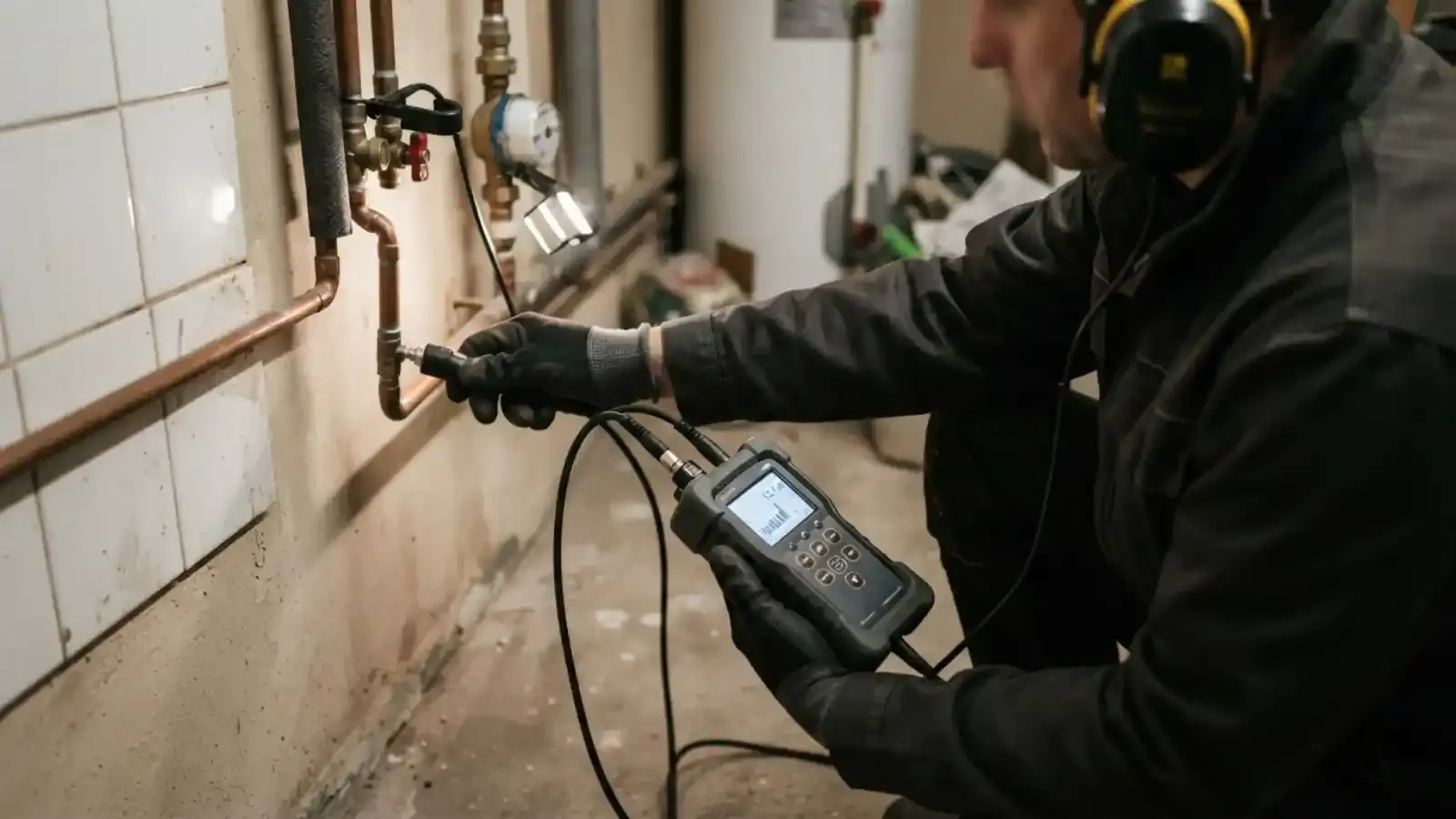
A plumber can pressurize a line and read a gauge, which isolates the leaking section without opening a wall. Acoustic listening gear picks up the hiss of escaping water through floors and slabs. Thermal cameras show warm or cool streaks where hot lines or wet materials sit.
None of these is a magic wand. Good detection combines tools with the reading you already took from the meter. That is why the number you wrote down matters, and the next call is easier when you can say what the dial did.
When to call a plumber instead of hunting on your own
- The meter moves with everything off and the dye test is clean.
- A wall, ceiling or floor is wet and you cannot see the source.
- The yard has a soft patch you did not water.
- Water is flowing and you cannot stop it at a valve.
- You hear running water inside the wall.
Write it down
Note the time, the meter reading and what you turned off. When a plumber arrives, that short log can save a lot of guessing, and it helps if you later need to explain a water loss to your insurer.
If any item fits, call (949) 325-3122. If water is actively flowing and you cannot stop it, close the main valve first. A split line or fitting may need burst pipe repair right away, and that does not wait for business hours.
The same checks work for neighbors in Dana Point and Rancho Santa Margarita. Cost depends on how many tests are needed, how deep or hard to reach the line is, and how much repair follows. Want your real number? Call (949) 325-3122.
Questions readers ask about this topic
Close the main valve at the house and watch the meter. If the dial stops, the leak is inside the house. If it keeps moving, the leak is on the line between the meter and the house, or at the meter itself.
Yes. A slow leak can soften wood, lift paint, grow mold and stain ceilings for a long time before it shows. Finding it early is cheaper than repairing the damage.
No. A few drops of food coloring wash out on the next flush. Some people use dye tablets, which work the same way.
In older buildings, check under sinks, around the water heater and at any exposed pipe or fitting. If you manage a historic property, ask the San Juan Capistrano building department before opening finished walls.
Call a plumber who does leak detection. If it sounds like an active flow, close the main valve first and then call (949) 325-3122.
Done reading and still have water where it should not be? Call now.