
How to Detect a Slab Leak in San Juan Capistrano, CA
Slab leaks hide in concrete, but they leave clues: a warm floor, a meter that will not stop and the sound of running water. Here is how to confirm one in San Juan Capistrano before anyone cuts the floor.
Water already escaping? Skip the reading and call.
How to tell if water is leaking under your slab
The two most reliable clues are a water meter that keeps moving when every fixture is off, and a floor spot that feels warm to bare feet. A slab leak is a break in a water line buried in or under the concrete foundation. Because it is hidden, you detect it by its side effects: sound, heat, moisture and your usage.
No single sign proves it, so look for two or three together. A meter that spins plus a warm tile near the kitchen is far stronger evidence than a musty smell alone. The rest of this guide ranks the clues from strongest to weakest and shows what confirms them.
- A warm or hot patch on the floor even when no one used hot water.
- The sound of running water when everything is off.
- A meter dial that creeps when every fixture is closed.
- A water bill that climbed with no change in habits.
- Damp carpet, lifting laminate or cracked grout lines.
- A musty smell near baseboards that returns after cleaning.
- Water heater that seems to run more often than before.
The shutoff test that narrows the location
Start with the meter, since it is the least ambiguous clue. Shut off every tap, dishwasher, ice maker and irrigation zone, then check whether the low-flow dial or the small triangle is turning. If it moves, water is going somewhere.
- STEP 01
Read the meter.
Write down the number, or note where the dial points, with all water use off in the house.
- STEP 02
Wait without using water.
Give it a quiet half hour or so, then compare. Any change means a leak somewhere after the meter.
- STEP 03
Close the house main.
Shut the main valve where the line enters the house, then look at the meter again.
- STEP 04
Compare the two results.
If the meter stops, the leak is on the house side of that valve and could be under the slab. If it keeps moving, the leak is on the line between the meter and the house.
That last step matters because it changes who looks and where. A slab leak sits on the house side, so the fix is inside the footprint.
Hot spots, sounds and dampness: reading the clues
| Clue | What it may mean | How much to trust it |
|---|---|---|
| Warm floor spot | A leaking hot line is heating the concrete | Strong, but sun through a window can warm a floor too. |
| Hissing at night | Pressurized water escaping from a pipe | Strong if it persists with the heater off. |
| Meter moves with all use off | Water is leaving the system somewhere | Strong, but it does not say where. |
| Damp flooring or baseboards | Moisture reaching the surface | Moderate, since it also fits wall and drain leaks. |
| Higher bill | Extra water is being used | Weak alone, since many things raise a bill. |
A leak on the hot side is the easiest to feel, because hot water warms the slab. A leak on a cold line can be silent for a long time and shows up first as a meter that will not hold still. Check the floors in the evening or at night so afternoon sun does not fool you.
San Juan Capistrano note: rain, sun and the mild-climate false alarm
San Juan Capistrano gets about 13.6 inches of rain a year, and the mean daily high is about 71 F. Hard freezes are rare here, so a frozen pipe is an unlikely cause of a buried leak. When a slab line fails locally, the usual suspects are wear, corrosion and movement, not frost.
The mild climate also creates two false alarms. A wet patch outside after a storm may be runoff against the foundation, and a warm floor near a sunny window may be the sun. Test at night, and on a dry week, before assuming the water is coming from a pipe.
Source: San Juan Capistrano climate facts (rainfall and mean temperatures)
Meter spinning with everything off, or a warm floor spot? Call (949) 325-3122 before the damage spreads.
What pros use to pinpoint a slab leak
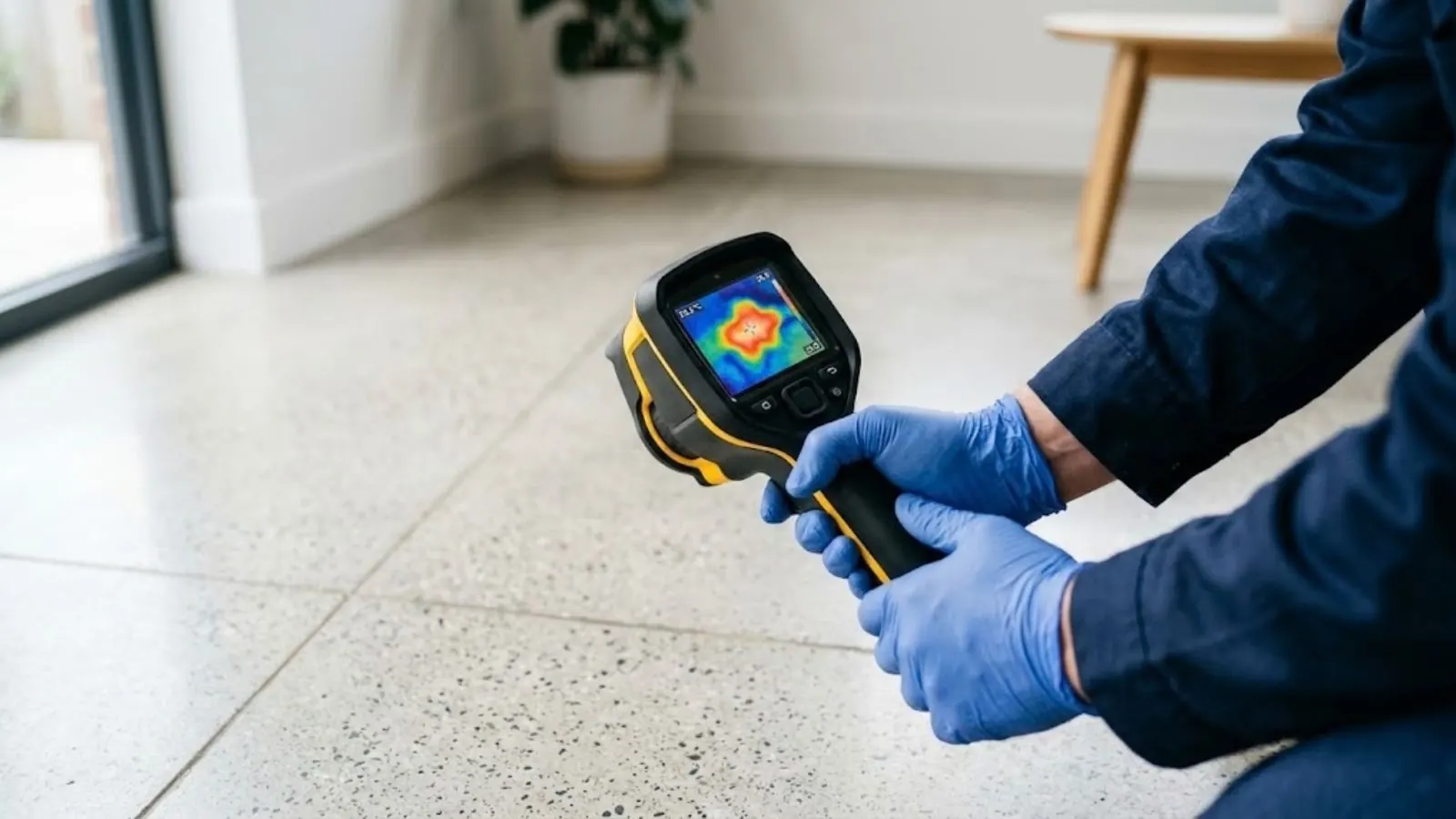
Guessing where to cut concrete is expensive and messy, which is why pinpointing comes first. Acoustic listening uses sensitive microphones on the floor to hear the sound of water escaping, and it works best when the line is under pressure. Thermal imaging shows warm lines on a hot-water leak, and pressure tests on isolated segments tell the technician which pipe is failing.
A good leak detection visit combines two or three of these so the opening in your floor is as small as possible. It also tells you whether the break is a single pinhole or a sign that the line is failing along its length, which changes the repair decision.
Next steps once you suspect a slab leak
Close the main valve if you hear water running or see it spreading, and call (949) 325-3122. Keep rugs and furniture off the suspect area so you can see changes. Take photos of any damp spots, the meter reading and the date, because your insurer may want a record.
Repair options depend on the line. A plumber can open the floor and fix the section, reroute the pipe overhead so it never touches the slab, or recommend replacing the line if the pipe is failing in more than one place. Each approach is covered under slab leak repair, and the right one depends on what the testing finds.
What to do first if water is spreading or you hear it running.
- Close the main water valve at the house.
- Turn off the water heater power or gas control if the floor is wet around it.
- Keep people and pets off wet floors near outlets or appliances.
- Move rugs, boxes and electronics away from the damp area.
- Call (949) 325-3122 and describe where the water or warmth is.
What affects the cost of finding and fixing a slab leak
Cost factors include how many tools the pinpointing takes and how deep the line sits. Flooring removal and restoration matter too, as does whether the repair is a spot fix or a reroute. The age and material of the remaining pipe also play a part. Water damage already done to flooring or drywall is a separate item.
Homeowners insurance often covers sudden accidental damage that results from a leak, but not wear or the cost of repairing the pipe itself. Policies differ, so ask your insurer before work begins, and ask the plumber for the written findings you will need. For a firm price after pinpointing, call (949) 325-3122.
Leaks that look like slab leaks but are not
A damp patch can come from a drain line, a roof or window leak, a sweating cold pipe, or an irrigation line near the foundation. Outside, wet soil along the house after a storm points to grading and runoff more often than a pressurized line. A plumber rules these out with the same tests and tells you plainly if the slab is not the source.
The same tests apply in neighboring towns the crew covers, such as Mission Viejo and Rancho Santa Margarita. Mission Viejo was largely complete by 1980, and Rancho Santa Margarita is generally newer. Age changes how likely a line is to be failing, but it does not change whether the meter test works.
Questions readers ask about this topic
You can gather strong evidence. A meter that moves with all use off, a warm floor spot and the sound of running water are all things an owner can check. Pinpointing the break inside the concrete takes equipment, so the last step belongs to a plumber.
A hot-line leak warms the floor above it and may make the water heater run more. A cold-line leak is usually quiet and shows first as meter movement. Ask a plumber to test each line, since both can leak at once.
It can be. Water spreading across a floor, running sounds, or wetness near electrical items call for closing the main and calling (949) 325-3122. A slow leak is less urgent, but it still damages floors and bills, so do not wait for it to get worse.
Policies often cover sudden accidental water damage but not wear or the repair of the pipe. Ask your insurer before work begins, because coverage depends on your policy's wording and the cause.
With about 13.6 inches of rain a year, wet ground against the foundation can seep into a slab edge. If the meter is still and the dampness follows storms, runoff is the likelier culprit. If the meter moves, it is a line.
Done reading and still have water where it should not be? Call now.